

Growing, Cutting, Pruning: The Long Journey of Crafting & Editing
A behind the scenes look at what it took to create my latest poetry collection, RDPD--that from start to finish, took ten years in the making.

I feel like it seems there’s a misconception about how long it really takes to make and curate art, from its informal conception to a physical work that’s printed, bound, and distributed.
My mind goes to album cycles and how those typically last a year, to bestselling novelists casually explaining that something only took them six months before they sent it to their agent or editor.
And then there are those anomalies, people who bite the bullet and admit that their book took six, ten, twenty years.
I’m shocked to admit that mine is one of them—I honestly didn’t think it’d take so long.

Not because I assumed I’d be snatched up by a publishing house fresh out of college (although I wished for it daily). Moreso because I didn’t anticipate the trajectory this project took on, which spanned many seasons of the same rhythm: growing, cutting, and pruning. Two steps forward, one step back, until it was actually ready to be submitted and well-received.
As I’ve mentioned before, this collection was my college thesis. For poetry, this was just a short(ish) collection of at least 40 pages. Mine was 65, only slightly ambitious. But still a decent size for a poetry book. They even bound it for us (albeit in a spiral-style like a notebook, bleh) so we could really imagine it. Still, it felt complete, in its collated glory. So I thought it was done a long time ago.
Spoiler alert: it clearly wasn’t.
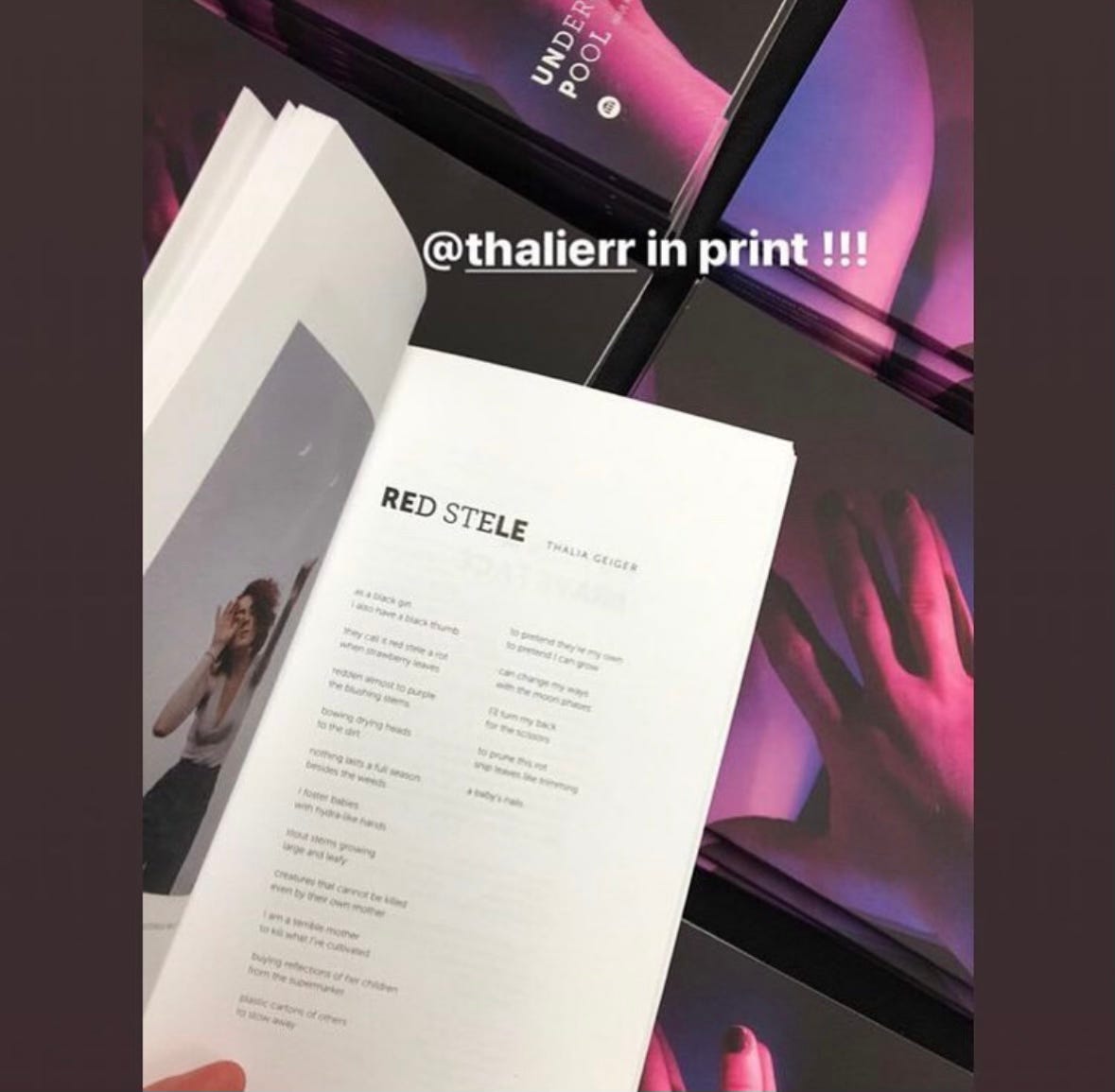
And if I published that thesis, I’d definitely be cringing at it by now. As an impatient woman, I’ve always wanted my work to hit the ground running soon after I finish it, while I’m still high from the excitement of completion. (Or, in some cases, perceived completion—as most of the time, once that high wears off, I realize it’s actually shit and I have to go back in for another tedious edit.)
And that’s exactly what happened, over and over again.
With some lessons along the way.
Reading is Writing.
After three years of rejected submissions, I returned to the dusted pages and realized my mistake. The manuscript simply wasn’t as good as I thought. I had been reading poetry submissions as a part time assistant for The American Poetry Review, and my new knowledge about how poems should work made the issues in my old poems glaringly apparent.
It helped me look at my own work with the same keen eyes. If I was reading this in a pile of a thousand other poems, would this catch my eye? The answer was no.
So I applied my newly sharpened expertise, did a hefty round of edits and sent it back out on submission. I did get at this time what I still call the best rejection of my life: a kind “upon closer look, this ultimately doesn’t work for us” from my dream poetry press. I honestly lived off that elation for a couple years. (And still do.)
But the message was the same, just now with literal proof of what the editorial voice in the back of my head (growing louder by the day!) was telling me:
We can do better.
So what was one more round? That rejection set a goal for me—although I’m still not published by that dream publisher (yet…), it reminded me that my work was even worthy of a closer look.
Life is an Editor.
Eventually, time passed, life happened, and the excitement for this project naturally waned. I wasn’t actively working on it during the whole of the last ten years—because, well. That would be tortuous and disastrous, wouldn’t it?
But time flew. I was living my life. I was working on other projects, turning my focus elsewhere, and gained more knowledge of what works from a few more poems published.
I wrote a whole other manuscript, then moved onto another! I was driven by life: the overturning of Roe V Wade happened in 2022, and a little voice asked, Well what if you made a new collection on your reaction to this? I went ahead and wrote (and published!) that chapbook in the meantime, then out popped Wild Like a Woman in 2025.
The main point is, after years of working hard on one project alone, I gave myself the well-needed permission for a break from the material. But I never stopped writing. From this “break,” only bigger and brighter things were born, giving me back the energy and motivation to dive back in and refine my old ideas.
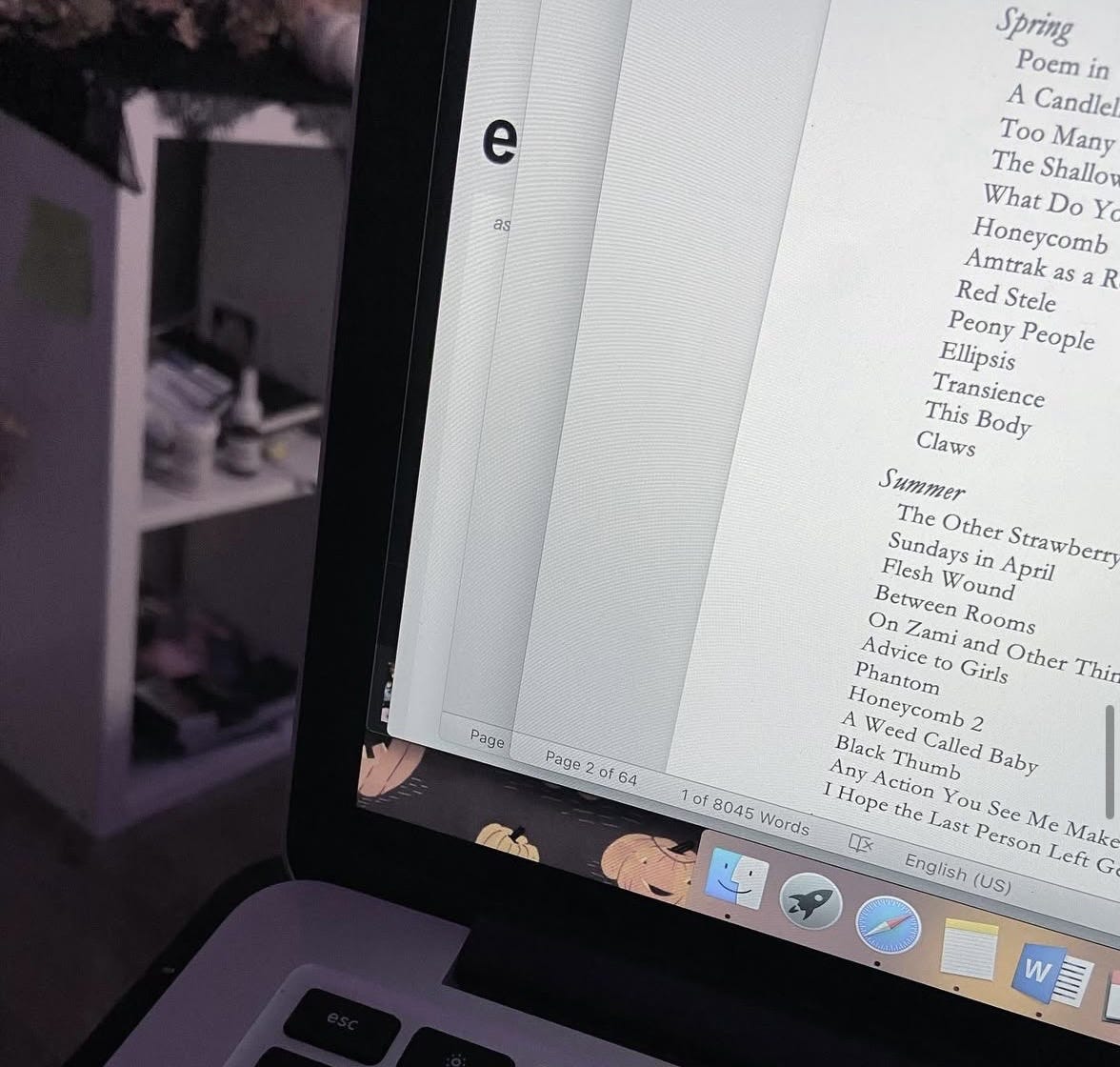
I did one last edit to comb through the tiny tangles. Got rid of the poems that no longer resonated, wrote a completely new title poem that gave the manuscript a facelift and a new name. It felt so much stronger, so much more razor-focused than any other poem in the entire manuscript—who knew I just had to write it several years later?
That’s the version I sent off on one last submission, and that’s the version that published in February (thank you, Thirty West Publishing).
It took real life, and the ups and downs of several seasons for me to realize what it lacked, and what I needed.

So if you’re wondering how long a project will take, or you’re stuck in an endless loop of editing, treat it like its own entity. Let it breathe, let it change shape. You can even let it disappear. It might just return on its own with a straighter back and more resolve you didn’t know it had. Or maybe it’s replaced by a new idea with all its solid parts.
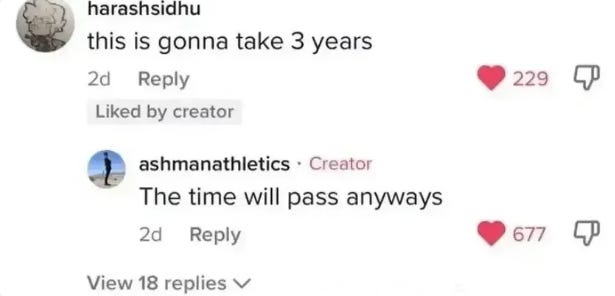
Time will pass anyway, so let the process do what it must so your work can stand on its own two legs.
And don’t fear time, because it will only do what it does: change the both of you for the better.
If you’ve made it this far, thank you, I love you dearly. & My poetry book is out! Get it here: